What Are the Top Extruded Aluminum Profiles in 2026?
What are the top Extruded Aluminum Profiles in 2026? The answer depends on application, alloy, temper, surface finish, and verified performance. A slim 6063 profile may suit a window frame, while a 6061 or 6082 section may better support machinery, transport equipment, or solar structures. The strongest profile is not always the best profile.
Industry data supports this practical question. The International Aluminium Institute’s Aluminium Sector Greenhouse Gas Pathways to 2050 describes rising long-term aluminium demand and emphasizes lower-carbon production. The Aluminum Association’s Aluminum Statistical Review also tracks expanding use across transportation, construction, packaging, and industrial markets. These reports do not rank individual profiles, but they explain why efficient, recyclable, and lightweight sections remain commercially important.
This guide examines leading profiles by real-world value. It considers 6063 for architectural frames, 6061 for general structural work, 6005A for stronger hollow sections, and 6082 for demanding load-bearing applications. Thermal-management profiles also deserve attention, especially as electric vehicles, battery systems, and data centers require compact heat dissipation. A profile’s wall thickness, corner radius, extrusion difficulty, and tolerances can change its performance significantly. Small details matter.
Reliable selection requires more than a catalog label. Engineers should review mill certificates, temper designations, dimensional tolerances, corrosion protection, and testing records. The European Aluminium Association and relevant ISO standards provide useful technical reference points, although standards alone cannot replace project-specific validation. This overview may simplify some choices, and that is its weakness. Actual performance still depends on design, processing, installation, and service conditions.
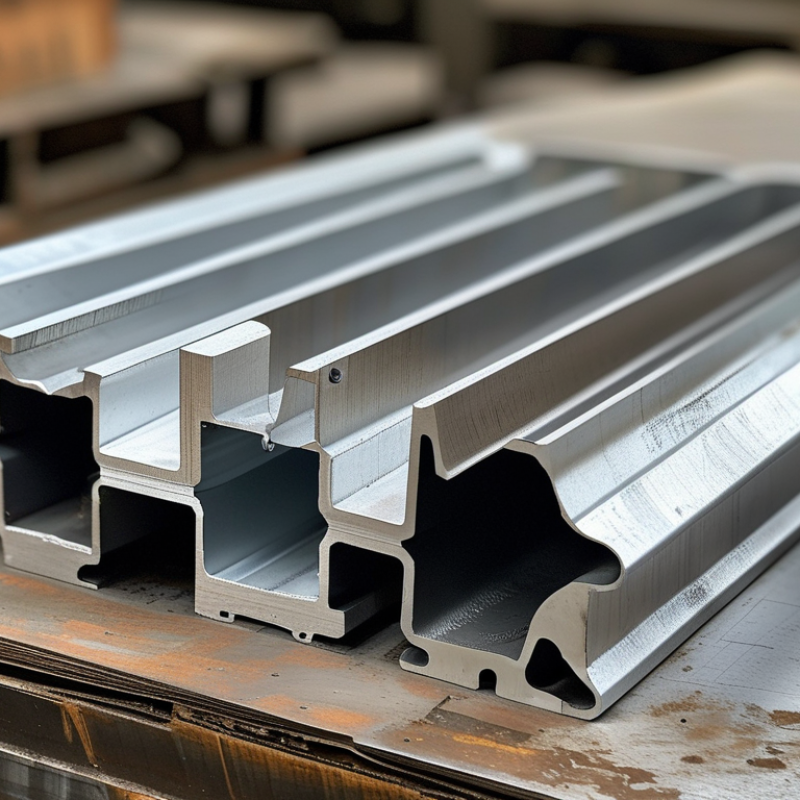
How Extruded Profiles Are Ranked: Alloy, Temper, Shape, and EN 755 Data
What Are the Top Extruded Aluminum Profiles in 2026?
How Extruded Profiles Are Ranked: Alloy, Temper, Shape, and EN 755 Data
The strongest profile is not always the best profile. In 2026, engineers usually rank extruded aluminum by alloy, temper, geometry, and verified EN 755 performance. EN 755-2 lists mechanical properties by alloy and thickness. For example, EN AW-6082-T6 can reach about 250 MPa proof strength and 290 MPa tensile strength in selected dimensions. EN AW-6060-T66 is lower, often near 150 MPa and 195 MPa. Wall thickness changes the result.
Alloy selection follows the load and finish. EN AW-6060 and 6063 are widely favored for clean surfaces, tight shapes, and architectural sections. EN AW-6082 ranks higher for frames, platforms, and load-bearing components. Temper matters too. T6 improves strength through solution heat treatment and artificial aging, while softer tempers can support bending and forming. Shape is equally practical. Deep cavities, thin webs, and sharp corners may reduce extrusion speed or dimensional stability.
EN 755-9 provides profile tolerance data, including straightness, twist, and cross-sectional limits. These figures help separate a premium design from a merely attractive drawing. European Aluminium market outlook data continues to show strong demand for lightweight transport and construction solutions. Still, rankings can mislead. I would recheck every strength value against section thickness, die design, and supplier test certificates. Real profiles are less perfect than catalog tables.
What Are the Top Extruded Aluminum Profiles in 2026?
Ranking basis: representative minimum tensile strength (Rm) values from EN 755-2 for commonly used extrusion alloys and tempers. Actual requirements vary with wall thickness, profile geometry, and delivery condition.
How the profiles are ranked: Alloy and temper determine mechanical performance, while shape determines application suitability. 6082-T6 and 6061-T6 are typically selected for higher structural strength; 6005A-T6 offers a balance of strength and extrudability; 6060-T66 and 6063-T6 are widely used for architectural and heat-dissipating profiles.
6063-T5 Architectural Profiles: 152 MPa Minimum Tensile Strength
What Are the Top Extruded Aluminum Profiles in 2026?
6063-T5 architectural profiles remain widely selected for doors, window frames, curtain walls, partitions, and decorative trims.
The key specification is a minimum tensile strength of 152 MPa.
This value indicates the stress an extrusion can withstand before breaking. It does not describe yield strength, stiffness, or long-term durability.
Details matter.
During profile selection, I check the alloy certificate, temper designation, wall thickness, and dimensional tolerances. A profile with thin corners may meet the tensile requirement but still deform during cutting or installation. Extrusion shape also affects performance. Deep channels, sharp transitions, and uneven walls can create local stress concentrations.
Surface quality deserves equal attention. Anodizing can improve appearance and support corrosion resistance, while powder coating offers broader color choices. Neither finish repairs poor extrusion quality. Profiles should arrive straight, clean, and free from dents that could expose weak areas. Storage conditions matter too; stacked lengths can twist when unsupported.
A common mistake is treating 152 MPa as a complete design guarantee. It is only one mechanical requirement. Engineers should also review load calculations, connection details, fastener placement, and environmental exposure. Test results can vary with section size and testing methods. That is why current inspection records are more reliable than a generic catalog statement.
Some projects still choose oversized profiles for confidence. That can increase material use without solving connection problems. Careful detailing often matters more.
Heat-Sink Profiles: Up to 237 W/m·K Thermal Conductivity
Extruded aluminum heat-sink profiles remain a strong choice for thermal management in 2026. Their key advantage is efficient heat spreading through lightweight, recyclable metal. Some high-conductivity aluminum materials can reach up to 237 W/m·K. This figure depends on alloy, temper, temperature, and testing conditions.
Profile geometry often matters as much as conductivity. A thick base transfers heat from the component into the fins. Closely spaced fins increase surface area, but overly narrow gaps can restrict airflow. In a real enclosure, a 2 mm base and 20 mm fins may perform better than a larger profile with poor ventilation. Natural convection needs wider spacing than forced-air cooling.
Small details matter.
Engineers should check the thermal interface, mounting pressure, surface flatness, and contact area. A profile with impressive laboratory data may underperform after anodizing, cutting, or uneven assembly. I have seen designs focus heavily on the 237 W/m·K claim while ignoring fan direction and dust buildup. That is an easy mistake. Reliable selection requires verified material certificates, thermal simulations, and practical testing with the intended load. Results should be measured under realistic airflow and ambient temperatures, not ideal bench conditions.
Thermal-Break Window Profiles: U-Values Near 1.0 W/m²·K
Thermal-break window profiles are among the most capable extruded aluminum solutions in 2026. Their design separates interior and exterior aluminum with polyamide or similar insulating barriers. This reduces conductive heat transfer through the frame.
A near-1.0 result is impressive. However, it can mislead. The U-value may describe the frame, not the complete window. ISO 10077-2 calculations distinguish frame performance from whole-window performance.
The U.S. Department of Energy reports that windows can contribute 25–30% of residential heating and cooling energy use. Better frames therefore matter, especially in large glazed façades.
High-quality thermal-break systems can approach Uf values near 1.0 W/m²·K when paired with deep cavities, insulated chambers, low-emissivity glazing, and warm-edge spacers. Whole-window Uw values depend on glass size, edge detailing, hardware, and installation. Small gaps matter. Poor sealing can weaken excellent calculations.
The European Commission’s building-performance guidance supports a whole-assembly approach, rather than judging profiles alone. Independent testing under EN 14351-1 and calculation methods under ISO standards improve comparability. Still, laboratory results are not perfect field results. Thermal bridges at corners, fasteners, and sills deserve closer review. A practical specification should request declared values, test conditions, tolerances, and installation details before selecting an aluminum profile.

 Catalog
 Replacement Cushions
 New Jersey Catalog