
Top Aluminum Extrusion Profile Types for Buyers in 2026
Choosing an Aluminum Extrusion Profile in 2026 is less about picking the most impressive shape and more about matching its section to the job. A T-slot profile may simplify assembly on a machine frame. A heat-sink profile needs fins that release heat without making production impractical. Structural, architectural, and custom profiles each bring different trade-offs in stiffness, finish, weight, and cost. Small details matter. A thick corner can change die flow; a tight tolerance can raise machining costs.
Thomas Sheppard, an established author on aluminium extrusion, has examined how alloy, tooling, and process affect the finished section. Paraphrasing a practical lesson from that technical work: “A profile works best when its design, alloy, and production route suit its intended use.” Buyers should compare alloy and temper, wall thickness, tolerances, surface treatment, and expected order volume. Ask suppliers how they control these details, and request drawings or sample parts where appropriate.
Price alone can mislead. A low-cost standard profile may need extra machining, while a custom die may pay off across repeat orders. But not always. The right choice depends on the load, assembly method, operating environment, and finish requirements. This guide introduces the main profile types buyers are likely to encounter in 2026, along with practical questions to ask before approving a design. Some decisions still require testing; a drawing cannot reveal every production issue.
What Aluminum Extrusion Profiles Are and How They Are Made
Aluminum extrusion profiles are continuous shapes made by pushing a heated billet through a shaped steel die. The die determines the cross-section, from a simple angle to a hollow channel with internal ribs. The process suits 6xxx-series alloys, which balance strength, corrosion resistance, and workability. Small details matter.
In direct extrusion, a hydraulic ram presses the billet through the die, and the emerging profile is cooled, straightened, and cut to length. Heat treatment can then adjust strength: T5 profiles cool after extrusion and undergo artificial aging, while T6 profiles receive solution heat treatment before aging. Wall thickness, corner radii, and hollow-section complexity affect die design, cost, and achievable tolerances. A drawing that looks simple can still prove difficult to extrude.
Material choice also shapes a buyer’s decision. The International Aluminium Institute reports that recycling aluminum uses about 95% less energy than producing primary aluminum, though recycled content and performance depend on alloy control and processing. Ask suppliers for alloy, temper, dimensional tolerances, and inspection details—not just a profile sketch. Even a well-made extrusion may need machining or finishing, and that adds cost. The trade-off deserves attention.
How Extrusion Profiles Are Classified by Shape and Structure
Aluminum extrusion profiles are commonly classified by their cross-sectional shape and internal structure. Solid profiles have no enclosed cavities, as seen in flat bars, angles, and channels. They are often easier to specify when a design needs a simple mounting edge or a stiff, uncomplicated section. Hollow profiles contain one or more enclosed spaces. Square and rectangular tubes can provide useful stiffness without using solid metal throughout.
Some sections sit between these groups. Semi-hollow profiles have a narrow opening into a partly enclosed cavity, which can make die design and extrusion more demanding. The opening’s width matters. So does the wall thickness around it. A drawing may look tidy, but uneven walls can affect material flow and dimensional consistency.
Structure should match the job, not just the appearance. A frame carrying loads across a long span may need internal webs to limit bending. A cover or trim piece may need only a light, open shape. Check where fasteners, seals, and cut ends will sit; these details can expose weaknesses that a cross-section alone does not show. Not always obvious. Buyers should confirm tolerances and finish requirements with the supplier, especially for intricate cavities. One useful question is whether the chosen profile can be extruded consistently at the required length and wall thickness. A more complex shape is not automatically a better one. Sometimes the simpler section is easier to inspect and assemble.
Top Aluminum Extrusion Profile Types for Buyers in 2026
How extrusion profiles are classified by shape and structure
Profile types are commonly distinguished by their cross-section. Solid and open profiles have no enclosed cavities; hollow profiles contain one or more. These counts describe representative cross-sections—actual designs vary by application.
Common Aluminum Extrusion Profile Types Available to Buyers
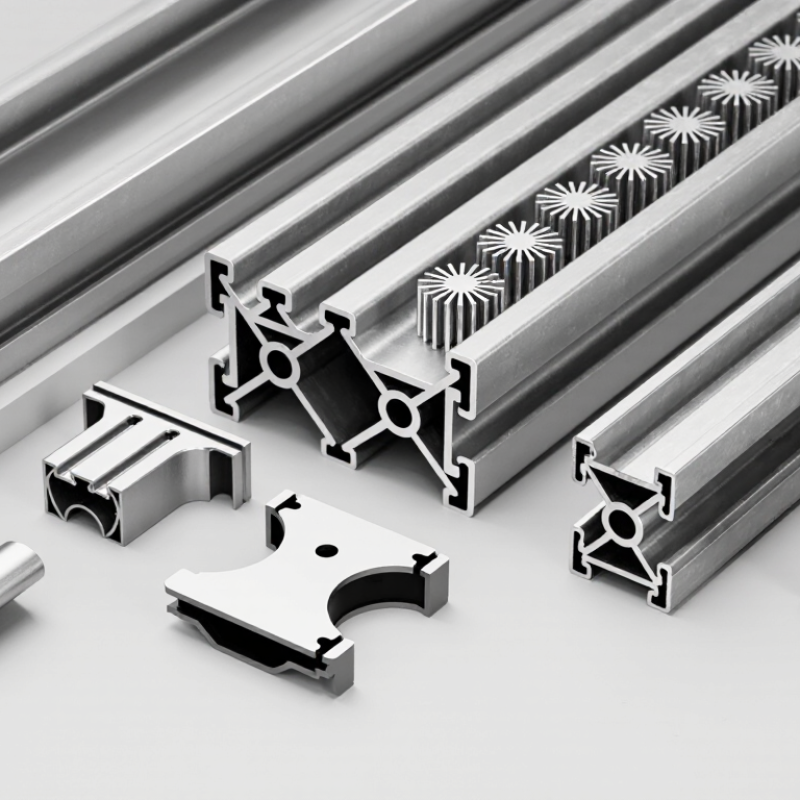
Aluminum extrusion catalogs typically group profiles by cross-section: solid, hollow, and semi-hollow. Solid angles, channels, and T-sections suit brackets, frames, and edge supports. Square and rectangular tubes provide enclosed cavities for posts and machine guards. Round tubes work well for handrails and fluid-routing assemblies, while custom heat-sink profiles use fins to spread heat. Small details matter. Check wall thickness, corner radii, and slot dimensions against the mating parts; a profile that looks standard may still need machining.
Buyers should match the shape to its load, environment, and joining method. A hollow section can reduce weight, but thin walls may dent or complicate fastening. Anodizing or coating may improve surface performance, yet finish allowances can affect tight fits. The International Aluminium Institute estimates that about 75% of all aluminum ever produced remains in use, underscoring the material’s long service life and recycling value. That figure does not guarantee a particular extrusion can be recycled efficiently: alloys, coatings, and mixed assemblies also matter. One practical check is to request the alloy, temper, dimensional tolerances, and finish specification together. Catalog selection is useful, but it is not a substitute for testing a prototype under real loads.
| Profile Type | Typical Geometry | Common Alloy and Temper Options | Typical Applications | Buyer Considerations |
|---|---|---|---|---|
| T-Slot Structural Profile | Extruded bars with longitudinal T-shaped slots, commonly in square or rectangular cross-sections. | Often 6063-T5 or 6063-T6; alloy and temper availability depends on the design and supplier. | Machine frames, workstations, guards, modular fixtures, and automation equipment. | Check slot dimensions, fastener compatibility, profile straightness, and whether connectors are available for the chosen system. |
| Square or Rectangular Hollow Tube | Closed hollow sections with square or rectangular outer dimensions and a defined wall thickness. | Commonly 6063-T5 for general-purpose sections; 6061-T6 may be specified where higher strength is needed. | Frames, supports, enclosures, furniture, and lightweight structural assemblies. | Compare wall thickness, corner radii, dimensional tolerances, and load requirements; hollow sections may need internal support for some machining operations. |
| Round Tube | Hollow circular section specified by outside diameter and wall thickness. | Common options include 6063-T5 and 6061-T6, depending on strength, finish, and fabrication needs. | Handrails, frames, fluid or air conduits where suitable, and general fabricated assemblies. | Confirm inside diameter, wall thickness tolerance, straightness, end condition, and suitability for the intended pressure or structural use. |
| Angle Profile | L-shaped section with equal or unequal legs and a specified wall thickness. | Often available in 6063-T5 or 6061-T6; verify the temper for the required strength and formability. | Brackets, edge trims, frames, supports, and corner reinforcement. | Specify leg lengths, thickness, inside radius, and whether sharp or rounded corners are acceptable. |
| Channel Profile | U-shaped or C-shaped section with a web and two flanges. | Commonly produced in 6063 or 6061 alloys; temper is selected according to mechanical and finishing requirements. | Tracks, mounting rails, framing, cable supports, and protective edging. | Check internal clearance, flange dimensions, wall thickness, and the space needed for brackets or sliding components. |
| I-Beam or H-Section | Section with two flanges connected by a central web; proportions vary by application. | Alloy and temper vary by design; 6061-T6 is a common option when strength is a priority. | Lightweight supports, structural frames, machine components, and load-bearing assemblies designed for aluminum. | Confirm section properties and obtain engineering review for the intended load, span, support conditions, and connections. |
| Heat-Sink Profile | Base section with multiple fins designed to increase exposed surface area. | 6063 is widely used for heat-sink extrusions because of its extrusion and surface-finish characteristics. | LED fixtures, power electronics, motor drives, and other thermal-management assemblies. | Compare base thickness, fin spacing and height, mounting features, and thermal performance under the actual airflow and operating conditions. |
| Architectural Profile | Visible sections with application-specific grooves, covers, glazing pockets, or decorative contours. | 6063-T5 and 6063-T6 are commonly used; finish options may include anodizing or powder coating. | Window and door systems, curtain-wall components, partitions, and decorative trims. | Review finish requirements, color consistency, drainage details, mating-part dimensions, and applicable building-system specifications. |
| Custom Extrusion | Purpose-designed cross-section developed around required functions, interfaces, and manufacturing constraints. | Alloy and temper are selected to balance strength, extrudability, corrosion resistance, and finishing needs. | Equipment housings, specialized frames, transport components, and integrated mounting or assembly parts. | Provide a dimensioned drawing, material and temper requirements, tolerances, finish, estimated annual volume, and any testing or certification needs. |
Where Different Profile Types Are Used Across Industries
Aluminum extrusion profiles earn their place through fit, not appearance. In vehicles, hollow and multi-channel sections can serve as battery-tray rails, seat structures, or cooling passages. The IEA’s Global EV Outlook 2024 reported nearly 14 million electric cars sold worldwide in 2023, about 18% of all car sales. That growth increases interest in lightweight, integrated components. But each design still needs validation for loads, joining, and crash performance.
Buildings use profiles differently. Box sections and custom mullions frame windows and curtain walls; slimmer channels support solar panels and facade shading. UNEP’s 2023 Global Status Report for Buildings and Construction attributed 34% of global energy demand and 37% of energy- and process-related emissions to the sector. Well-designed frames can support efficient envelopes, though glazing and installation matter just as much. Details count.
Factories and equipment makers often choose T-slot profiles for adjustable workstations, guards, and conveyor frames. Electronics rely on finned heat-sink profiles to spread heat from compact components. A small channel can simplify cable routing. Yet custom shapes may increase tooling costs and complicate replacement parts. Buyers should compare section strength, finish, tolerances, and assembly method against the actual operating environment—not just the catalog drawing.
How to Choose an Aluminum Extrusion Profile in 2026
Top Aluminum Extrusion Profile Types for Buyers in 2026
How to Choose an Aluminum Extrusion Profile in 2026
Choose the profile around its real job, not its appearance in a catalog. A T-slot section suits adjustable frames, while a channel can guide panels or protect wiring. Loads matter. For a cantilevered bracket, check the unsupported length, load direction, and deflection—not just the profile’s outer dimensions. Ask the supplier for alloy, temper, tolerance, and mechanical-property data before comparing quotes.
The International Aluminium Institute projects global aluminum demand could rise by about 40% by 2030. That growth makes material efficiency and supply planning worth considering when specifying a profile. (International Aluminium Institute, 2023.)
For outdoor use, check corrosion resistance and drainage; trapped water inside a hollow section can create trouble. For assemblies with sliding parts, request the dimensional tolerances that affect fit. A beautiful drawing is not a production guarantee.
Also consider machining, joining, and surface finishing early. The U.S. Department of Energy notes that recycling aluminum uses about 95% less energy than producing primary aluminum. (U.S. DOE, “Aluminum Recycling.”) Recycled content may support lower-impact sourcing, but verify the supplier’s documentation and required alloy properties.
One trade-off is easy to miss: a thinner wall can cut weight, yet may increase flex or complicate fastening. Test a sample assembly if the load or fit is critical.

Catalog
Replacement Cushions
New Jersey Catalog